If you have ever walked away from a crying child at drop off and spent the whole drive wondering what happened the moment you were out of sight, here is the honest answer: most children stop crying within two to ten minutes of you leaving, once a caregiver offers real comfort and connection first, a warm voice, a steady presence, a reminder that you are coming back, and only then redirects their attention to something familiar and hands-on. The tears you saw at the door are rarely the whole story. What happens after you leave your child at daycare is usually calmer, faster, and more ordinary than the goodbye made it feel.
This post contains affiliate links. As an Amazon Associate and member of other affiliate programs, I earn from qualifying purchases at no extra cost to you.
Get the essential checklist every parent needs before the first day of daycare. Sent straight to your inbox, free.
Get Your Free ChecklistFifteen years of standing at that door has taught me something parents rarely get told: the hardest part of drop off is not the crying itself. It is the not knowing. You hand your child to someone else, you walk out, and then the day closes over like water. No update arrives for hours, so your mind fills in the gap, usually with the worst version of what happens after you leave.
I understand why. Love does that. But the actual gap between the goodbye and the calm is almost always shorter than the imagined one, and understanding what really happens in that gap can change how the whole morning feels for you, not just for your child. If you already work on what to say the night before daycare and keep that part calm, the morning goodbye tends to be shorter too, which makes what happens after you leave even easier on everyone.
Here is the play by play I have watched more times than I can count. In the first thirty seconds after a parent walks out the door, a child often does look for you, sometimes at the door itself, sometimes just with their eyes scanning the room. This is normal and it is not a sign that something is wrong.
One expectation trips up more parents than almost anything else: waiting at the door for the crying to stop before you actually leave. It rarely works that way. If a child is going to cry at goodbye, they will likely cry at that goodbye, and probably the next several, for as long as separation still feels hard, not because you stayed one more minute to watch. What actually changes over time is not whether tears show up at the door. It is how fast they pass once you are truly gone. Lingering to wait it out often backfires, because a child quickly learns that more crying, or crying a little longer, can keep you standing there, or even convince you to take them home. A short, clear goodbye, even through tears, teaches something far more useful: that the goodbye always happens, on schedule, and that crying does not change that.
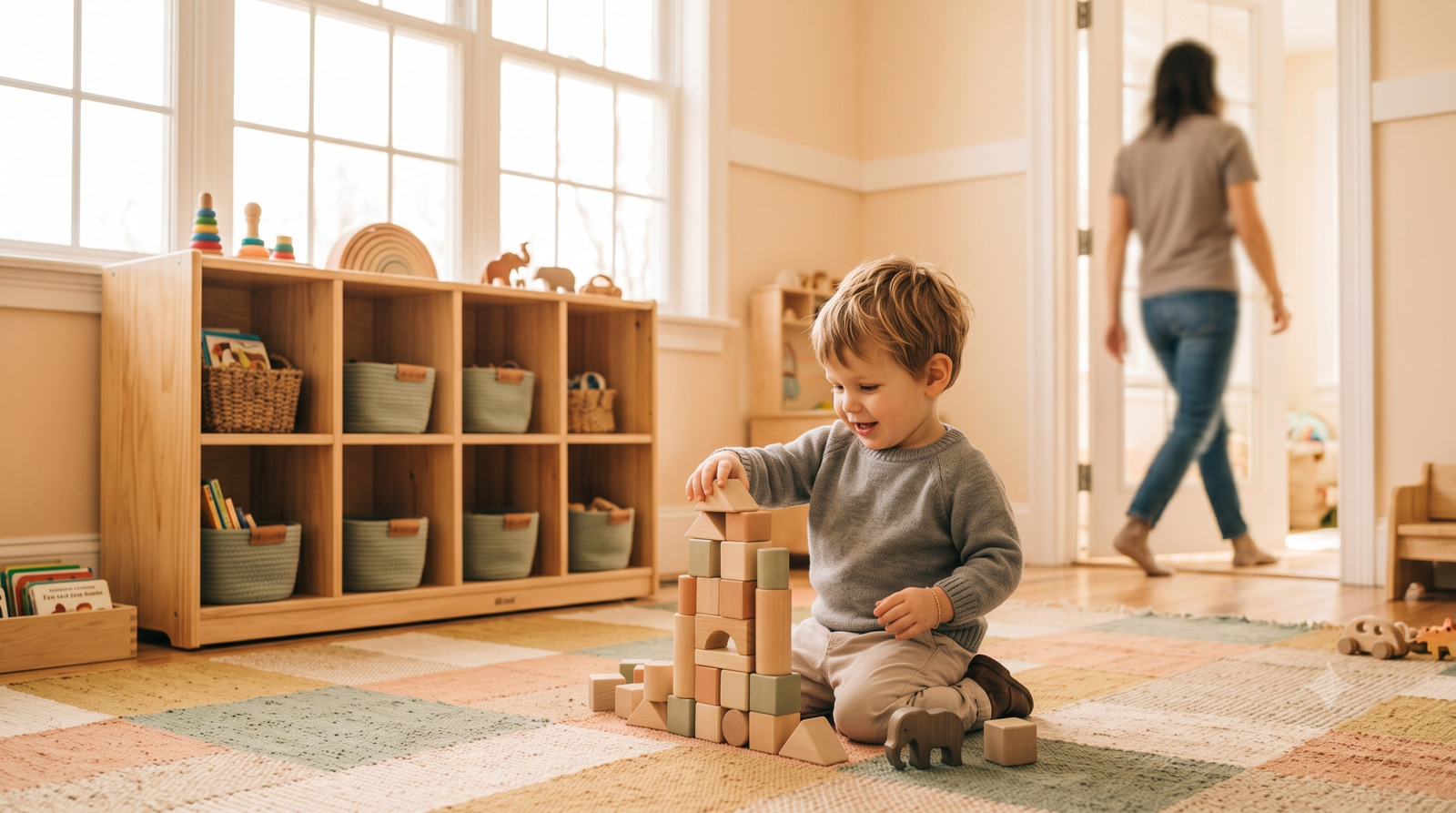
A good caregiver does not ignore the moment right after you leave, or rush past it. We name the feeling out loud (“You miss Mom, and that is okay”), and follow it with the words that matter most, that you are coming back for them, that they are safe here, and that we are right beside them to help. Only then do we offer a bridge, something concrete and physical to hold onto: a favorite puzzle already out on the table, a spot next to a familiar friend, a job to do like handing out napkins at snack time. The goal is never to distract a child out of a feeling. It is to give their hands and attention somewhere to land, once they know they are safe and held, while the feeling passes on its own.
Most children take that bridge within a few minutes. By the five minute mark, a child who was sobbing at the door is very often sitting quietly, watching the room, sometimes still teary but no longer in distress. By ten minutes, most are fully engaged, not performing calm for anyone, just actually calm. The loud, dramatic goodbye and the quiet, settled child twenty minutes later are both true. They just happen to different versions of the same morning, and this is the part of what happens after you leave that most parents never get to see for themselves.
If your mornings still feel shaky at the door itself, the goodbye ritual matters as much as anything that comes after it. A short, consistent routine, the same words, the same hug, the same wave, teaches a child that the goodbye always ends the same way, which makes what happens after you leave easier to predict and trust.
Once a child has settled, the day takes on its own rhythm, and rhythm is doing a lot of the emotional work here. Free play or arrival activities come first, low pressure and self directed, which gives a child room to ease in without being asked to perform or participate before they are ready. Circle time follows, with songs and a group routine that is the same every single day, which matters more than it sounds like it should. Predictability is calming in a way that novelty never is.
Snack time tends to be a natural checkpoint. Sitting down with the same group of children at the same table, most kids who were tearful at drop off are chatting, eating, sometimes even laughing, well before the morning is half over. Outdoor time or a longer activity block follows, and by this point a child who struggled at the door is usually indistinguishable from any other child in the room, fully inside the day rather than still standing at its edge.
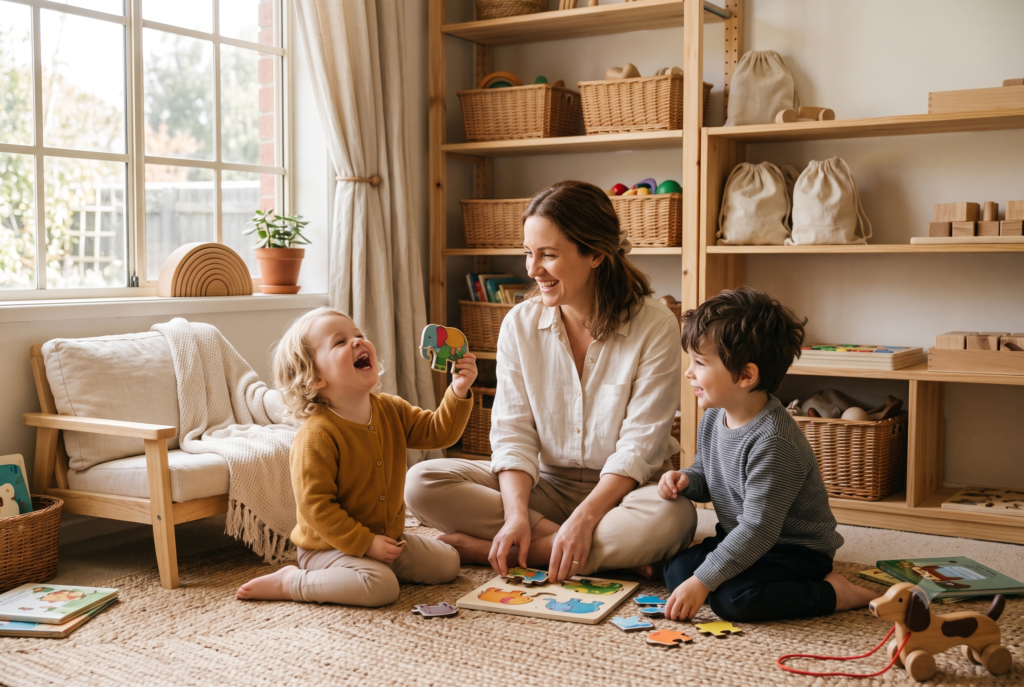
One boy I taught, I will call him Theo, used to cry so hard at drop off that his mother would linger at the door, which, understandably, only stretched the goodbye out and made it harder for both of them. She once asked me, almost afraid of the answer, “What actually happens after I leave? Does he cry the whole time?” I walked her through it plainly. Most mornings, he cried for about four minutes, always near the block corner, always calmed by the same job, carrying the attendance clipboard to my table. By the time she would have been pulling into her office parking lot, he was already building, already talking to the friend next to him, already fully in his day. Once she believed that, really believed it, her own goodbyes got shorter and calmer, and his did too. Children read our certainty more than our words, and a shorter, steadier goodbye at the door changes what happens after you leave more than any speech ever could. Pairing a calm goodbye ritual with a consistent daycare drop off routine tends to shrink that window even further over a couple of weeks.
It can feel counterintuitive, but a child who cries hard and then recovers quickly is showing you something reassuring, not something worrying. According to the American Academy of Pediatrics, separation anxiety is a normal, expected part of healthy development, evidence of a strong attachment rather than a sign that anything is wrong. A fast recovery after a hard goodbye tends to reflect a child who trusts, even mid protest, that the separation is temporary and that you are coming back.
The children who worry me more, in fifteen years of watching this pattern, are not the ones who cry hard and then settle. They are the ones who show no reaction at all, who hand themselves over flatly with no visible feeling either way. That is worth mentioning to a teacher. A hard cry followed by real recovery is, almost always, exactly what it looks like: a securely attached child having a hard, brief moment.
Babies and young toddlers (0 to 2 years): What happens after you leave at this age is mostly about a trusted caregiver and physical comfort, being held, rocked, or walked around the room. Object permanence is still developing, so a predictable person and a predictable routine matter far more than any words could.
Preschoolers (3 to 5 years): This is the age where the bridge activities matter most, a job, a friend, a familiar toy. Preschoolers can also hold a simple concrete idea of when you are returning (“after snack”), which shortens the emotional tail of the goodbye considerably.
Kindergarten age (5 to 7 years): Older children usually settle the fastest of all, often within a minute or two, because they can understand and rely on the daily schedule almost like a clock of their own. When kindergarteners do struggle, it is more often a specific day (a substitute teacher, a schedule change) than a general pattern.
Most mornings follow the pattern above, but not every one will, and an occasional harder day does not undo the progress you have made. If a child is still distressed well past the fifteen or twenty minute mark on most days, that is worth a real conversation with the caregiver, not because something has gone wrong, but because a few small adjustments (a different bridge activity, a shorter goodbye, a consistent ritual at the door) usually close that gap faster than waiting it out alone.
This is exactly the stretch where a little more structure helps. My ebook, Daycare Ready Without Tears, walks through The Gentle Start Method step by step, including how to shorten a slow settling window and what to do differently at the door when the first few weeks are harder than this article describes.
What happens after you leave your child at daycare is, for the overwhelming majority of children and mornings, far calmer than the goodbye suggested. A brief cry, a bridge activity, and a settled child within minutes is the normal pattern, not the exception. The rhythm of the rest of the morning, circle time, snack, play, does most of the remaining work. If your child is still struggling to settle past that window, it is fixable, not a sign that daycare is the wrong choice or that something is wrong with your child.
You do not have to guess what happens after you leave anymore, and you do not have to carry that worry through your whole morning. Want more honest, practical support for the daycare transition? Join over 100 parents getting weekly tips from a real classroom. Learn more about Lauren
Thank you for supporting my work! In this post, I am recommending toys that we truly love and use at Playful Minds Lab. As an Amazon Associate I earn from qualifying purchases.