An honest daycare drop off routine from a real classroom, the simple ritual that eases tears and helps your toddler settle in faster each morning.

by Lauren Hayes, Early Childhood Educator
If your child cries every time you leave daycare, the fastest fix is not a longer goodbye or a better explanation. It is a short, predictable daycare drop off routine that you repeat the same way every single morning. Children under three do not calm down because a situation is explained to them well. They calm down because it is familiar, and familiar is something you can build on purpose.
I have watched hundreds of drop offs from the other side of the door, and the ones that go smoothly almost always have one thing in common. The parent is not improvising each morning. They have a routine, and they trust it enough to actually follow it, even on the hard mornings when it would be easier to skip a step. If you are not sure if your child is ready yet, that is a separate question worth working through before you focus on the routine itself.
This post contains affiliate links. As an Amazon Associate and member of other affiliate programs, I earn from qualifying purchases at no extra cost to you.
Get the essential checklist every parent needs before the first day of daycare. Sent straight to your inbox, free.
Get Your Free ChecklistToddlers do not have the language or the emotional regulation to process a long explanation at 8am, no matter how gently you say it. What they can do is recognize a pattern. Same steps, same order, same words, every day. That predictability is what actually helps a young child feel steady at drop off, not the content of what you say in the moment.
Think of it less as convincing your child that leaving is fine, and more as giving them a map they already know by heart. A child who knows exactly what happens next, coat off, cubby, shoes, one hug, goodbye, does not need to brace for the unknown, because there is no unknown left in that ten minute window.
This lines up with guidance from HealthyChildren.org, the American Academy of Pediatrics parent site, which recommends creating the same goodbye routine every day to help ease a child’s distress at drop off. This is step one of what I call The Gentle Start Method with the families I work with. Before you can work on anything else, whether it is a tearful goodbye or a child who clings at the door, you need one thing in place first, a daycare drop off routine that does not change from day to day, even when your child is having a hard morning.
A good daycare drop off routine has roughly the same shape for almost every family I have worked with. What changes are the small, personal details inside it, the exact words, the specific hug, the little joke that only your child understands. The routine itself sits inside a bigger picture, and if the whole first week still feels overwhelming, my full first day of daycare tips walks through everything else you can prepare in advance.
The routine does not start at the classroom door, it starts in your kitchen or your car. Keep the morning itself calm and unhurried wherever you can manage it. Rushing at home almost always shows up as resistance at drop off ten minutes later, because your child feels your pace before you ever say a word about where you are going.
You do not need a long conversation about the day ahead. A short, calm heads up is enough, one or two sentences about what is coming next, said in a matter of fact tone, not a negotiation you are opening up for discussion. If you have time in the days before, reading these picture books before the first day can give your child the language for what is coming, without any pressure attached to it.
This is the part most parents skip, and it is the part that matters most. As you walk in, describe out loud, in short, calm phrases, exactly what is happening. Here is your cubby. Let’s take off your shoes and put on your slippers. This kind of narration turns an unpredictable moment into a sequence your child can follow and anticipate, step by step, instead of a blur of adult conversation happening around them.
Keep your full attention on your child during this part of the daycare drop off routine. Not your phone, not a conversation with another parent, just your child and the next small step. That presence is what makes the narration land, not the specific words you choose.
Every family’s goodbye looks a little different, and that is exactly as it should be. It might be a specific phrase, a particular hug, a small wave through the window. What matters is that it is short and it is the same every day, regardless of how the morning is going.
Say goodbye once. Do not sneak out, and do not let the goodbye repeat itself three times because your child asked for one more hug. Both extremes teach your child that the ending of drop off is negotiable, and that uncertainty is exactly what a good daycare drop off routine is meant to remove.
How you communicate with your child’s educator in that moment matters more than most parents realize. A calm, warm handoff, where your child can see that you and the educator are relaxed and familiar with each other, tells your child this place is safe before they fully trust it themselves. Children read our nervous systems long before they understand our words, so your calm has to be real, not performed.
A consistent daycare drop off routine matters most for children under three, whose sense of time and trust is still developing. That is where I see the biggest difference between families who have a routine and families who are improvising each morning.
Preschoolers, roughly ages three to five, generally need it too, just with less intensity. They have more language and more ability to hold onto the idea that you are coming back later. Even so, keeping the same steps and the same short goodbye still helps on mornings that are harder than usual, a new sibling at home, a change in schedule, or simply a rough night of sleep. The routine matters a little less every year, but it rarely stops helping completely.
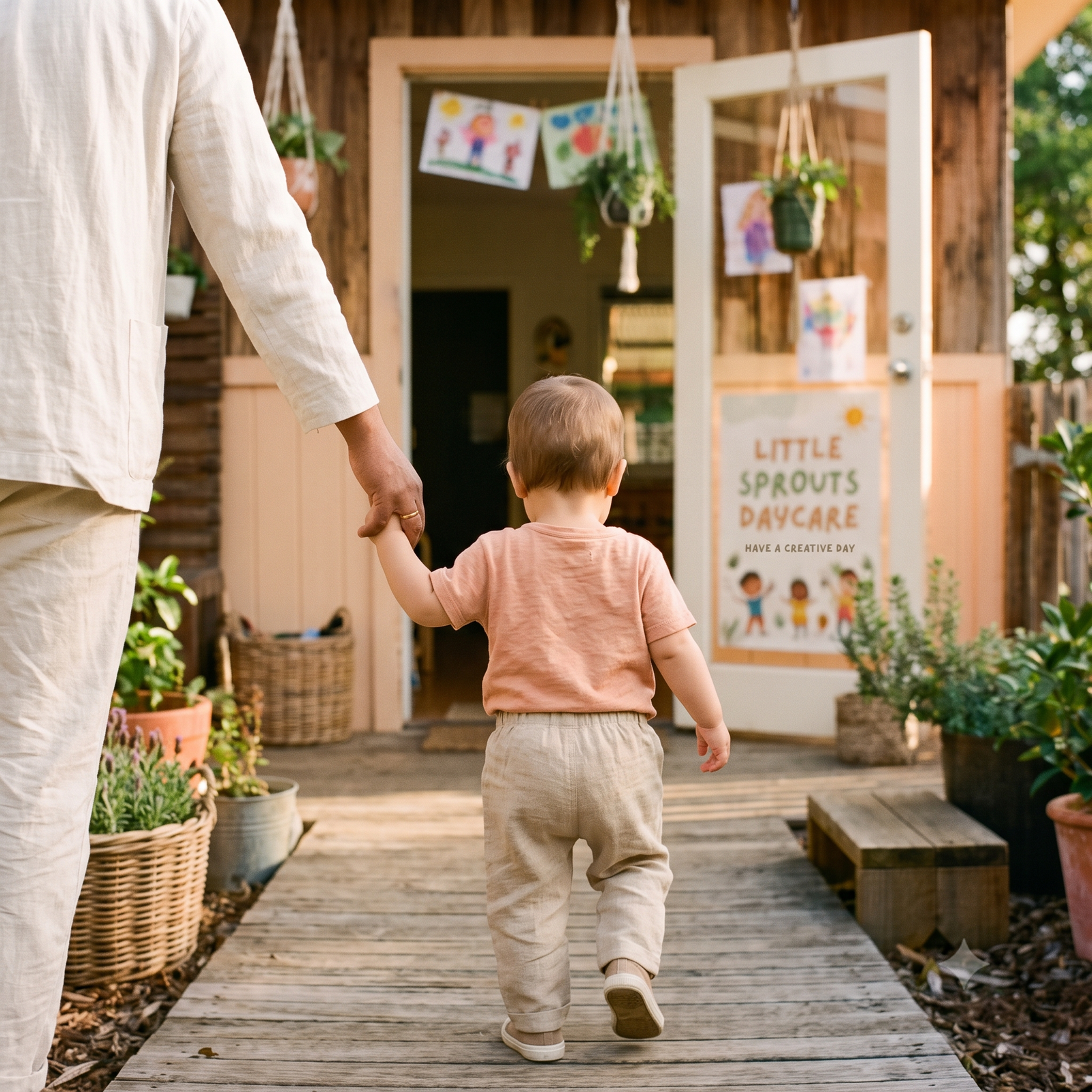
Most mornings, drop off is quiet, almost unremarkable to watch from the outside, and that is exactly the point. A parent walks in holding their child’s hand and starts narrating before they are even through the door. Here is your cubby. We are going to take off your shoes and put your slippers on. There is no rushing and nothing performed about it, it is just the two of them moving through the same small steps they move through every single morning.
I stay close but I do not step in unless I am asked to. Most parents manage the goodbye themselves, a specific phrase, a particular hug, and then they wait for their child to turn and walk toward the room on their own. I only take a child from a parent’s arms when the parent needs the help, not before that.
Once the parent has gone, my first move is never redirection. If a child looks upset, I acknowledge that first, a few words of comfort before anything else, then I tell them what we are doing in the room right now, and I offer breakfast. Comfort first, then information, then an activity, in that order. The children who get this sequence tend to settle faster than the ones who get cheerfully redirected before anyone has acknowledged that leaving is hard.
Most struggles I see at drop off are not really about the child. They are small breaks in the routine itself, usually made with good intentions.
Rushing through the steps because you are running late changes the pace your child expects, and they notice immediately, even if you think you are hiding it well. Sneaking out without a goodbye might buy you a tear free exit once, but it usually makes the next drop off harder, because your child learns you might disappear without warning at any moment. Drawing the goodbye out longer when your child is upset feels comforting in the moment, but it often prolongs the distress instead of shortening it, because it signals that more upset gets more time.
Switching to a new approach every few days is another common one. It is tempting to try something different the moment a routine has a rough morning, but a routine only works once it has been repeated enough times to become familiar. A rough Tuesday does not mean the routine failed, it usually just means Tuesday was hard.
The fix is rarely a brand new strategy. It is going back to the same short, calm daycare drop off routine and repeating it exactly, even on the morning it feels hardest to stick to.
Some children settle into a new routine within a few days. Others need longer, especially in the first weeks of daycare, and that does not mean the routine has failed. It usually means one part of it needs adjusting, the timing, the specific goodbye phrase, or how much comfort happens before the goodbye versus after it.
That troubleshooting, exactly what to change and in what order if your child is still struggling after two weeks, is what I walk through step by step in Daycare Ready Without Tears. The routine above is the foundation. The ebook is what to lean on when the foundation alone is not quite enough yet.
Get Daycare Ready Without Tears →
A daycare drop off routine will not make every morning painless, and it does not need to. What it gives your child is something to hold onto when everything else about the day feels new. Keep it short, keep it the same, and give it more time than feels comfortable before you decide it is not working. Most families I work with see the first real change by the second week, not the second day, and that second week is worth protecting the routine for.
Thank you for supporting my work! In this post, I am recommending toys that we truly love and use at Playful Minds Lab. As an Amazon Associate I earn from qualifying purchases.