
by Lauren Hayes, Early Childhood Educator
Signs your child is ready for daycare include a secure attachment at home, comfortable play and communication with a caregiver, and the ability to separate from you without lasting distress, even if the first drop offs still include a few tears. Readiness is not tied to a magic birthday. It is a cluster of small, everyday behaviors, and this guide walks through what they look like in real life, from a classroom, not a textbook.
If you are reading this at 11pm the night before your child’s first day, still not sure you are doing the right thing, you are not alone. Almost every parent I have handed a crying toddler back to at pickup has asked me some version of the same question: how do I actually know if my child is ready for daycare, or if I am pushing them into something too soon?
This post contains affiliate links. As an Amazon Associate and member of other affiliate programs, I earn from qualifying purchases at no extra cost to you.
Get the essential checklist every parent needs before the first day of daycare. Sent straight to your inbox, free.
Get Your Free ChecklistHere is something I will say plainly, even though it will not sell more ebooks: from a purely developmental standpoint, most children show far more interest in a group care environment, in the other children, in the room itself, after age three. Before that, it can still go well, but it takes more scaffolding from you.
I also know that is not always useful information. Parental leave in the US is short, and for a lot of families, the question was never “is my child ready,” it was “I have to go back to work in twelve weeks.” If that is you, this article is not a judgment. It is a set of honest signs your child is ready for daycare (or not quite yet), plus what you can actually do about it either way, because the age you enroll matters far less than what happens in the weeks around drop off.
I would rather tell you that plainly than write around it just to make a checklist feel more urgent. You cannot control your leave policy or your budget. You can control the goodbye, the honesty, and the routine around it, and that is where the real difference gets made. That difference is the real point of this whole list of signs your child is ready for daycare.
Readiness also is not only about age. A child who already has some practice being away from you, a weekend with grandparents, a playgroup, an older sibling who models “goodbye, see you later,” often settles faster than an only child starting completely cold, regardless of who is three and who is two. It is practice, not a fixed timeline, and every child gets a different amount of it before day one.
These are the signs I actually look for in the first days in my own classroom, not a generic checklist.
They have a secure base at home. Children who arrive with consistent attention and affection at home, who know someone always comes back, walk in calmer. That security travels with them.
They bring a piece of home with them. A favorite stuffed animal, a blanket corner, a specific water bottle. Children who are ready for daycare often lean on a small object like this as a bridge between two worlds, and it works.
They engage with play, not just tolerate it. A child who is ready will wander toward the blocks or the sand table within the first day or two, even shyly. A child who stands frozen at the door for a week is telling you something different.
They eat their meals. Not perfectly, not everything, but they eat. Appetite is one of the clearest physical signs of whether a child feels safe enough in a new space to relax.
They try to communicate with the caregiver. A pointed finger, a single word, a tug on my sleeve. Any attempt to reach out to an adult who is not you is a good sign your child is settling in, not shutting down.
They notice the other children, even from a distance. Full sharing and turn taking usually comes later, but watching, parallel playing next to another child, or reaching for the same toy someone else has, all count. You are not looking for a fully social child, just an interested one.
They can manage a few basics on their own. Getting an arm partway into a sleeve, using words or gestures to signal a bathroom need, feeding themselves finger foods. None of this needs to be perfect. A child who can do a little without you has an easier time when you are not there for a few hours.
If most of these are true, or become true within the first one to two weeks, your child is likely ready for daycare, even if goodbyes are still hard some mornings. Hard goodbyes and readiness are not opposites.

The signs I actually worry about are rarely about the child. They are about what happened before drop off.
The stress is coming from you, and they feel it. Children read a parent’s body before they understand a single word. If you are anxious, rushed, or guilty at drop off every day, that transfers directly.
Goodbye was forced or dishonest. Sneaking out while a child is distracted, or telling them you are “just going to the bathroom” and not coming back, breaks something specific: trust. A child who has been lied to about a goodbye does not calm down faster. They just stop believing you.
Big feelings got minimized. “Don’t cry, it’s not scary” tells a child their very real fear is wrong or silly. Children whose emotions get dismissed at home often arrive confused rather than upset, and confusion is harder for a teacher to work with than tears.
A few things worth watching on your child’s side too, not to diagnose anything, just to know when to loop in your pediatrician: no easing up on separation after several weeks of trying, no interest at all in the other children or the toys, real trouble telling you or a caregiver what they need, or worry that seems to interfere with eating, sleeping, or play well beyond the first month. Any one of these on its own is usually just a slower adjustment. If several show up together and stick around, it is worth mentioning at your child’s next checkup, not because something is wrong, but because a second opinion never hurts.
None of these are permanent. They are also not about your child being difficult. They are almost always fixable with a different goodbye script and a few honest words at home, which is exactly what The Gentle Start Method is built around.
A few years ago I had two children start in the same week, both around age two.
The first came in every morning holding the same worn rabbit. She had clearly been talked to about daycare beforehand. She cried for the first ten minutes, then put the rabbit in her cubby “to nap” and joined the play kitchen. By day three she was greeting me at the door.
The second child arrived without any warning about where he was, dropped off quickly while distracted with a snack so he “wouldn’t notice.” He noticed. For the first two weeks he wandered the room without settling into anything, watched the door more than his classmates, and flinched a little at loud sounds that hadn’t bothered him before. It took him nearly a month to do what the first child did in three days, not because he was a harder child, but because nobody had told him the truth about what was happening to him.
The difference was never the daycare. It was everything that happened at home before drop off. That is the real story behind the signs your child is ready for daycare.
One mistake I see often: a child has a smooth, even cheerful first few days, and the parent relaxes completely, certain they read the signs your child is ready for daycare correctly and the hard part is over.
Then, out of nowhere, week two brings tears at drop off that were not there on day one.
This is not a step backward and it is not a sign you got it wrong. Early comfort can simply be curiosity and novelty wearing off, followed by a child’s slower, more honest realization of what this new routine actually means. Educators sometimes call it delayed adaptation, and it is completely normal. Parents rarely expect it, because nobody warned them the real signs your child is ready for daycare show up over two to three weeks, not two to three hours.
When week two hits, the instinct is to panic or pull your child out. Neither helps. Keep the schedule steady, keep the goodbye script identical to day one, and give it another week before you decide anything has actually gone wrong. Most delayed adaptation resolves on its own once the child realizes the routine is not going to change no matter how hard they push against it.
Whatever age your child starts, a few things make an outsized difference in whether they show the signs your child is ready for daycare early or slowly, and none of them require waiting for a specific birthday.
Practice a short, honest goodbye script at home before the first real one. Let your child bring a comfort object and tell the teacher what it means. Never lie about where you are going, even a small lie. Name their feelings out loud instead of talking them out of having them (“You feel sad that I’m leaving. I’ll be back after nap.”).
Reading about it together helps too. I keep an updated list of the picture books I recommend for daycare transition if you want one to read the week before.
These are the first steps of The Gentle Start Method, and they matter more than the calendar date on your child’s first day. For the full walkthrough of the first morning itself, see my complete first day of daycare tips guide.
A few more that help in the first two weeks specifically: keep the drop off short, a long goodbye usually makes it harder on the child, not easier. Ask the caregiver what your child does in the hour after you leave, most children recover faster than parents assume. And resist comparing your child’s timeline to another child’s. The two week mark, the comfort object, the tears at the door, none of it moves on a fixed schedule.
Once you have checked the signs your child is ready for daycare above, the next hurdle is not emotional, it is logistical. What actually goes in the bag. What to prep at home the week before. What to say the morning of.
I put exactly that into a free printable checklist, the same bag list and week-before routine I hand to the parents in my own classroom, so you are not figuring it out at midnight the night before.
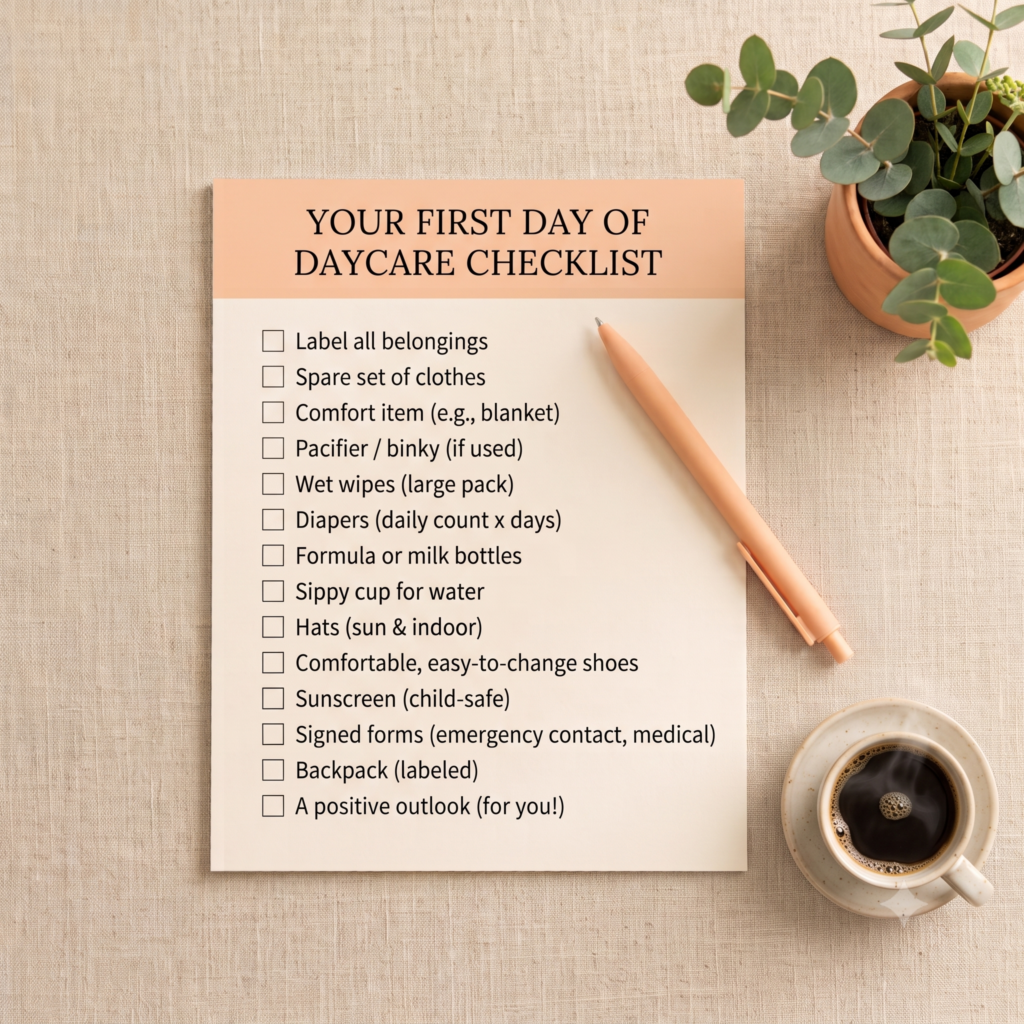
Get the free First Day of Daycare checklist above ↑
If you want to go deeper, the perfect drop-off script, what educators are really watching for, the red flags to know, and a full week-by-week 30-day plan, that is exactly what I built into Daycare Ready Without Tears, my complete guide for this transition using The Gentle Start Method.
Get Daycare Ready Without Tears →
There is no single day your child crosses a finish line into “ready.” There is a secure child, a honest goodbye, a comfort object, and a little patience for the two week mark. Watch for the signs your child is ready for daycare above, expect a wobble around week two even if the start was smooth, and remember that the age on the calendar matters far less than what you do in the weeks around it.
You know your child better than any checklist does. This just gives you language for what you are already noticing. That is what the signs your child is ready for daycare are really for.
Lauren Hayes is an early childhood educator with 15+ years in the classroom, specializing in daycare and school readiness. She is the creator of The Gentle Start Method and the author of Daycare Ready Without Tears.
Thank you for supporting my work! In this post, I am recommending toys that we truly love and use at Playful Minds Lab. As an Amazon Associate I earn from qualifying purchases.