
Figuring out how to choose the right daycare can feel overwhelming when all you really want to know is: will my child be safe and happy here?
Learning how to choose the right daycare comes down to ten concrete things you can ask and observe on a tour: playground safety, the child-to-teacher ratio, how teachers communicate with children, teacher education, teaching methods and daily activities, the daily routine, room size and group size, whether there’s dedicated time for parent conversations, and how the center handles the adjustment period. If you have more than one option nearby, comparing on these ten points will tell you more than a gut feeling alone.
This post contains affiliate links. As an Amazon Associate and member of other affiliate programs, I earn from qualifying purchases at no extra cost to you.
Get the essential checklist every parent needs before the first day of daycare. Sent straight to your inbox, free.
Get Your Free ChecklistNot every family gets to compare five daycares. For many parents, the choice comes down to whichever center is close enough to get to before work, and that is a completely valid reason to choose a place. But when you do have options, or even just one option and want to know what you’re walking into, knowing how to choose the right daycare helps you separate the things that actually predict a good experience from the things that just look nice on a tour.
A few years ago, I watched two families start their children in my group in the same week, both going through a rough adjustment period. One family kept coming, every day, even on the days their child cried at drop-off. Within two and a half weeks, that child was greeting me at the door. The other family started skipping days when the crying got hard. Two days one week, three the next, then a few days off entirely. Weeks went by and their child never had the chance to really get to know me, the routine, or the other children, because every time we were close to a breakthrough, the pattern reset. Eventually they decided the daycare “wasn’t working” and pulled their child out for good. It wasn’t the daycare. It was that inconsistent attendance during adaptation never gave the child a real chance to adjust. That family lost something real: a chance for their child to build friendships, new skills, and confidence, simply because nobody had told them how much the first few weeks depend on showing up.
Look at surfacing under climbing equipment, fencing, and whether equipment is separated by age group. A safe outdoor space matters just as much as what happens indoors, and it’s the one thing worth checking before anything else.

According to NAEYC, quality programs keep ratios around 1 to 4 for infants, 1 to 6 for toddlers, and 1 to 10 for preschoolers. Lower ratios consistently link to better language development and fewer injuries, so this is worth asking directly rather than assuming.
This is one you can partly observe on the tour. Watch how a teacher responds to a child who is upset or slow to follow directions. Warmth, patience, and a calm tone are good signs. A teacher who rushes past a crying child or dismisses tears without acknowledging them is a signal worth noting, and it often tells you more than any credential on the wall.
Ask directly about early childhood education credentials and ongoing training. A teacher with formal training in child development brings a different level of understanding to daily interactions than someone without it.
Ask what a typical morning looks like in terms of activities, not just “we do arts and crafts.” Structured but flexible programming that balances free play with guided activities tends to serve young children best.
Consistency in the schedule, meals, and nap times helps children feel secure. Ask how naptime and mealtime are handled, and whether the routine stays the same day to day.
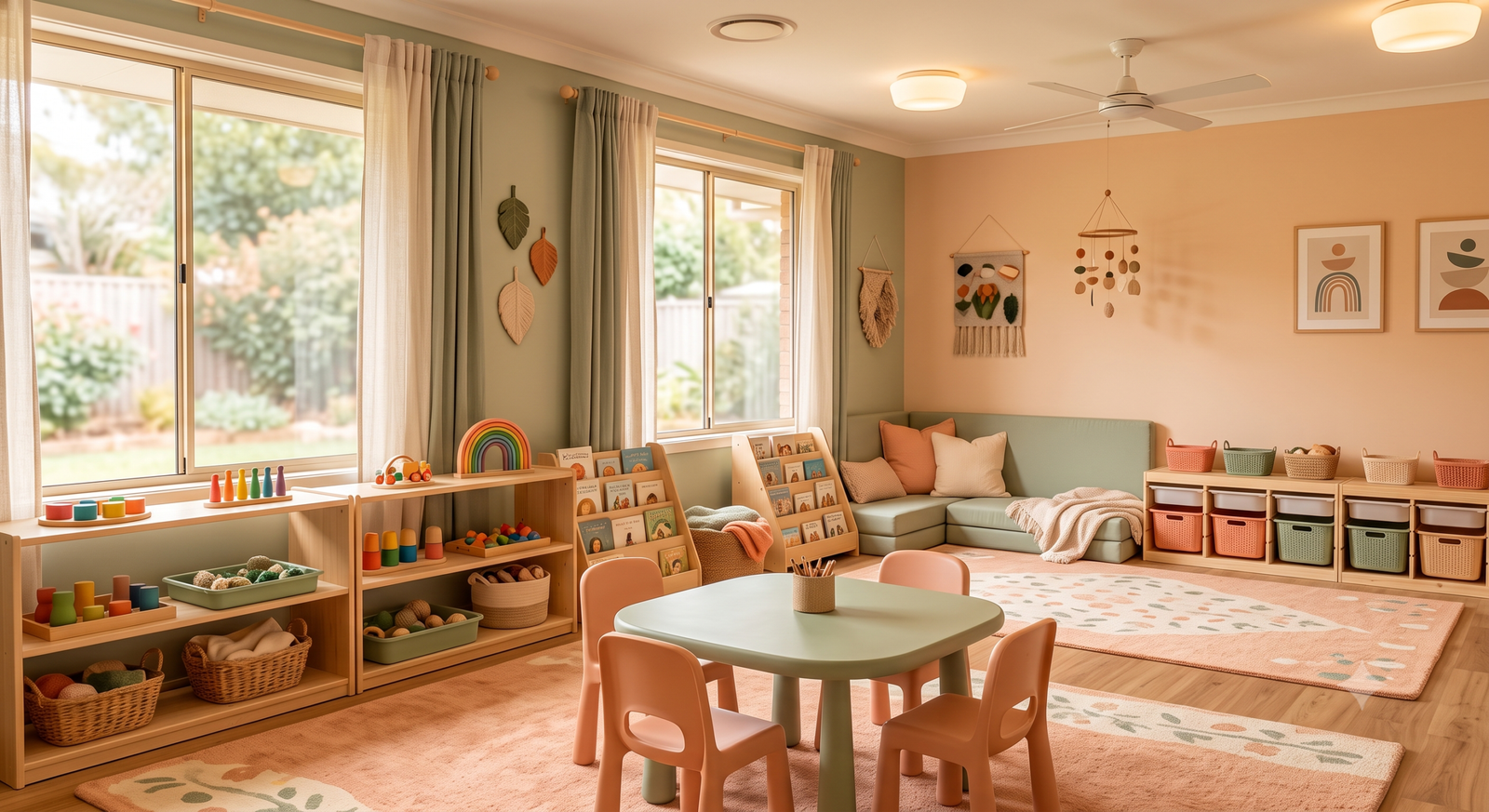
Ask to see the actual room your child would be in, not just a promotional photo. A crowded room with too many children for the space affects noise levels, movement, and how much individual attention your child gets. This overlaps with the ratio question above, so treat it as confirmation, not a separate deciding factor.
A teacher standing at the door during drop-off, managing a room full of children, cannot also have a full conversation with you in that moment, and that is normal, not a red flag. Ask instead whether the center has a specific time or system (a folder, an app, a scheduled check-in) for real communication about your child’s day.
Ask what they recommend if your child cries at drop-off, and how long they typically expect adjustment to take. A center with a clear, calm answer here (rather than “they’ll be fine” with no detail) usually has real experience supporting new families. If you’re also wondering whether your child is ready in the first place, these signs your child is ready for daycare can help you decide.
This is the question parents skip most, and it may matter more than any other one on this list. Ask whether the center recommends daily attendance in the first weeks, even on hard days, and why. As I saw firsthand, inconsistent attendance during adjustment can undo progress a child has already made.
A few signs are worth taking seriously even if everything else on the tour looks fine. High staff turnover, especially if more than one teacher mentions people “coming and going a lot,” tends to show up later as inconsistency your child will feel. A rushed or dismissive answer to your question about the adjustment period (“they all cry at first, don’t worry about it”) is different from a center that walks you through what support actually looks like. None of these are automatic dealbreakers on their own, but two or more together are worth pausing on.
Answers matter, but so does what you observe. Notice how staff talk to the children in the room, not just what a director tells you in the office. And if you don’t have the luxury of comparing multiple centers, use this list differently: as things to understand and ask about at your one option, so you know what to expect and how to support your child through it.
If there’s only one center available to you, use this list as a preparation tool instead of a comparison tool. Ask the questions anyway, especially about the adjustment period and attendance consistency, so you know what to expect and how to support your child through the first few weeks.
Two to three months before you need a spot is a reasonable window in most areas, though popular centers can have waitlists that stretch much longer. Starting early gives you room to actually compare, rather than accepting whatever has an opening when you’re up against a deadline.
When you know how to choose the right daycare, you’re not walking in blind. It doesn’t guarantee an easy start, but it does mean you’ll know what a strong daycare experience is supposed to look like once your child is settled in.
If you’re getting ready for the transition itself, my drop-off routine guide and the ebook Daycare Ready Without Tears walk through exactly how to make those first weeks easier, step by step, as part of The Gentle Start Method.
With warmth,
Lauren Hayes, Early Childhood Educator
Thank you for supporting my work! In this post, I am recommending toys that we truly love and use at Playful Minds Lab. As an Amazon Associate I earn from qualifying purchases.